
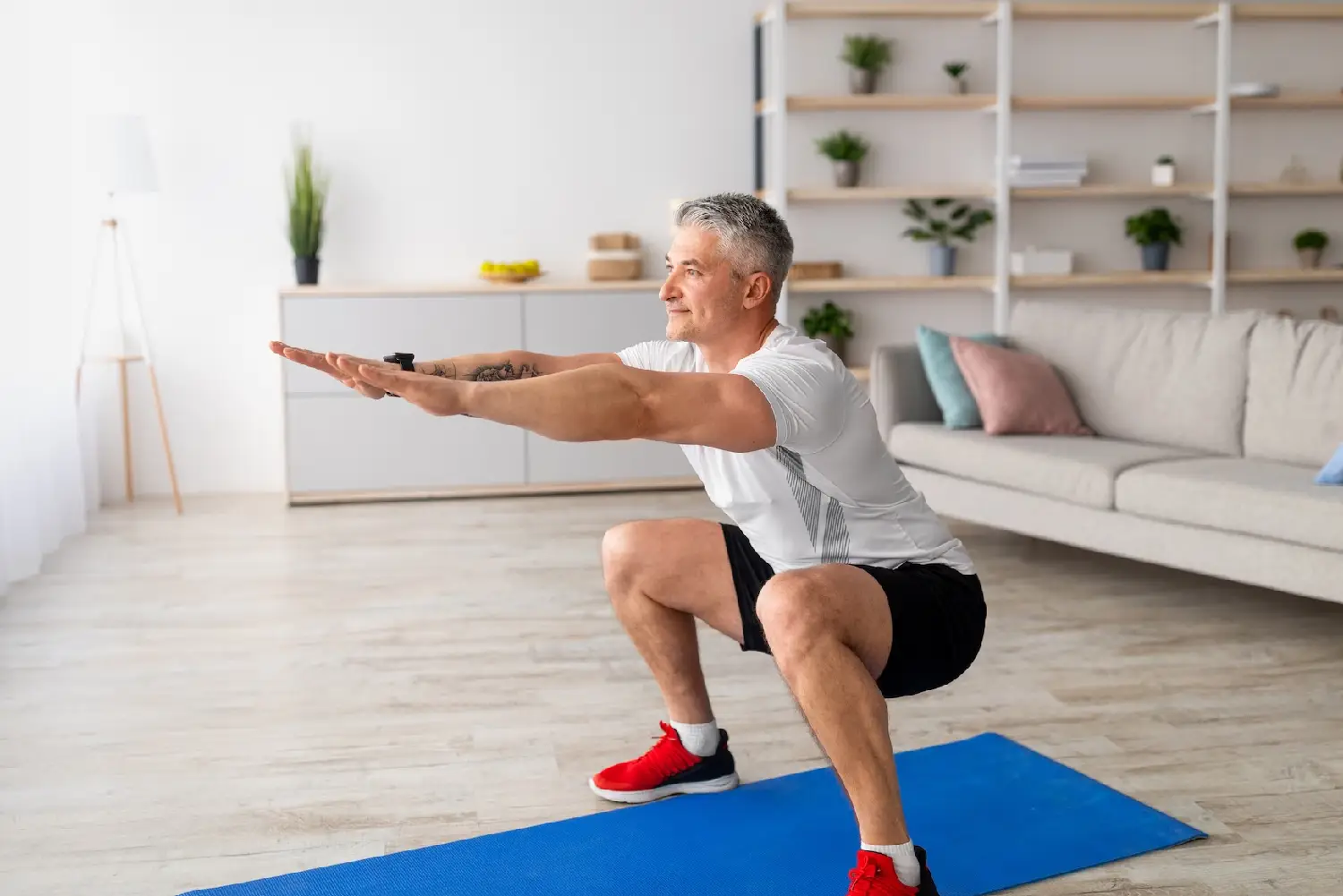
Building strength at home requires nothing more than your body, a clear floor space, and a commitment to regular practice. Bodyweight exercises are highly effective because they engage multiple muscle groups in functional patterns that mirror everyday movements – bending, pushing, pulling, and twisting. Before you begin, it’s wise to spend five minutes warming up by marching on the spot, rolling your shoulders, and performing a few gentle lunges to increase blood flow and joint mobility. Start with movements that feel accessible, such as a supported squat by holding onto a sturdy chair or doorframe. This allows your body to learn the pattern without strain, and as your confidence grows, you can gradually reduce support and increase depth. The emphasis should always be on controlled, smooth motion rather than speed or numbers.
Advertisement
A minimal home routine can be built around four foundational exercises: squats, push-ups, glute bridges, and plank holds. For squats, stand with feet shoulder-width apart, keep your chest lifted, and lower your hips as if sitting into a chair, ensuring your knees track over your toes without caving in. If a full push-up feels daunting, start with an incline by placing your hands on a kitchen bench or a sturdy table, maintaining a straight line from head to heels. Glute bridges involve lying on your back, knees bent, feet flat, and lifting your hips until your body forms a straight line from shoulders to knees, squeezing the glutes at the top. A forearm plank, held with a neutral neck and engaged core, builds endurance and stability. Perform each movement in two or three sets of eight to twelve repetitions, resting a minute between sets, and tailor the intensity to how your body feels that day.
Progression keeps the body adapting and prevents boredom. Once a basic squat becomes easy, slow down the tempo – take three seconds to lower and one second to rise – or add a pause at the bottom. Squat variations like split squats, where one foot is behind you on a low step, challenge balance and unilateral strength. Push-ups can become narrower to target triceps, and the feet can be elevated on a step to increase load. Incorporate a sturdy backpack filled with books to add resistance to squats or lunges. For lower-body pulling motions, which are harder to replicate without equipment, a simple door-mounted resistance band set available for a modest price opens up rows and pull-aparts that balance the pressing movements, supporting shoulder health. Regardless of equipment, the guiding principle is gradual overload: consistently asking your muscles to do a little more over time while maintaining excellent form.